Showing posts with label Planning. Show all posts

Friday, 14 July 2017

Should we use our Annual Performance Bonus to Top up our CPF?


As an employee, we would work very hard to secure our monthly pay-check and the ultimate annual performance bonus. Recently, I was engaged in various discussions on how to use our bonus. Some people even told me that the sum of money is causing them a headache because they do not know how to use it! Alamak, I really won’t mind helping you to solve this problem! 😜
So what would I do with my performance bonus?
For the initial years of my career, they would all end up transforming into shares investment or into my future funds such as emergency funds as well as expenses for wedding, house renovation, etc. From last year onward, I started to set aside up to S$7K to perform voluntary cash top-up to my CPF Special Account. Why? 
Like many, my initial considerations were just for the tax reliefs, potential gain from the CPF interest rate and to max up my CPF SA as quickly as possible. Later on, I wanted to open up the option of using my CPF OA money to pay for subsequent property investment. As I could only use the excess CPF OA savings above the CPF Basic Retirement Sum* for the purchase, cash top-ups & their interest returns would help to accelerate this process. My latest thought was that the money in CPF could also act as an “insurance” or “monetary support” for my wife/family members in the event that I suddenly pass on. Minimally the money could help to cover arising related expenses for my family. My personal philosophy on this is:
“We can be positive about the future but must be prepared and responsible for what happens next
Simply, I want to still be responsible for related matters even for the future beyond my life. If you are interested to find out more about cash top up to your CPF SA, I will recommend to start off with EzHuat’s article here.
Rambling a bit more about a related discussion among my fellow Huats, YoloHuat pointed out that people might not want to perform cash-top ups due to their upcoming payment needs. For this case, I fully agreed with her. Topping up our CPF is still an investment, and we should only do it using our spare cash! Recall that my personal experiences (see post) taught me to: ONLY INVEST WITH MY SPARE CASH.
There is no one-way of using our annual performance bonus and it would depend on the outcome that we hope to achieve. We have a choice on what we want to get out of it, for a good vacation to reward our family and ourselves, or for investments to prepare for financial-freedom, etc. Nothing right or wrong. Ultimately, we just have to be comfortable with the decisions made and be responsible for the subsequent outcome. :)
* Note that the Basic Retirement Sum is reviewed by CPF every year. As of now, savings in our CPF OA & SA (including amt used for investment under CPFIS-SA) can be used to meet this required amount.
Together, let us all Go & Huat ah!
GoHuat

Related Posts


Tuesday, 4 July 2017

Do You Know the Meaning of Financial Freedom?

I want to be financially free!

This is probably the dream of everyone. What exactly is financial freedom? How do you achieve it?

By convention via a linear pathway, we were taught to study hard, get good grades, enrol into good schools, go to the University. After graduation, you find a good-paying job and then work work work to climb up up up the corporate ladder. 

After going through all the stressful periods farming your hard earned money, you then feel the urge to spend spend spend to satisfy your material needs, pamper yourself like royalty on holidays, buy bigger houses, cash in on the latest car models etc. After splurging on those big-ticket items, you then feel the pinch and obediently goes back to work to earn back the money again. Sounds familiar? 

Indeed, most people trade the bulk of their time for a paycheck. I'd term this a 'vicious cycle in perpetuity'. In other words, it is a self-imposed rat race. 

What is financial freedom?
As the name suggests, it means being free financially where you can maintain your lifestyle without worrying about a monthly paycheck, bills, food and entertainment expenses etc. 

Financial freedom is not merely about having more money. We have seen wealthy people fall from grace and become bankrupts, high-income earners who had to slog/borrow/beg to pay off debts or people who seems to be rich on the outside but actually poor on the inside.

On the flip side, we also witness ordinary people who earns modestly and lives simply. Despite that, they are able to do what they like. They work because they want to work, not because they need to work. They can afford a yearly holiday trip and some occasional splurges yet don't feel a pinch in their wallet.

Achieving financial freedom is about how you make use of money wisely with a peace of mind.

If money is not an issue, what would you do?
To understand financial freedom, you need to ask yourself the question above.

Would you travel around the world?
Would you start a new business?
Would you spend more time with your loved ones? 
Would you spend your time volunteering and help the needy? 
Or would you take on new hobbies?

Being financially free gives you these options. 

Take control of your life
To achieve financial freedom, here are some simple steps you need to take:
- Avoid debts
- Spend less than what you earn
- Invest your spare cash
- Generate multiple income streams 
- Set your financial goals. Know what you are working towards to
- The earlier you start, the better
- Be grateful with what you have, don't compare with others

What does financial freedom means to you?
Building wealth is just part of the equation. There are many more aspects in life to appreciate such as building your health, happiness, dreams.

For me, financial freedom is more than just financials. It means having the time of freedom to do what I want to do. Instead of material possessions, I prefer to have freedom to spend time with my loved ones. Having the freedom to change my career, start a new business, take some time off to gain new perspectives through meditation, pursue my passion and dreams, travel the world to learn more about what this splendid world has to offer and celebrate for. 

It’s not about what I choose to do, it’s about having the freedom to choose who I want to be or do what I want in my life fulfillingly and meaningfully. 

Go forth and plan your financial journey. Believe in yourself and you will reap the fruits of labour eventually. 


I would love to hear your definition of financial freedom! I would appreciate if you could leave your comments below :)

Cheers, 
EzHuat


Saturday, 4 March 2017

The case for cash + Some thoughts on Warren Buffett's letter


As many of you know by now, the DJIA topped 21,000 for the first time ever with Trump’s latest speech to the Congress resonating strongly with the market. The speech offered slogans, few detail, yet the market keeps charging ahead. Strange world, isn’t it? Naysayers have stayed on the sidelines waiting for a correction to come, yet they are getting left behind in the dust.

Source: Google images

There’s a theory going around that there’s just too much cash lying around waiting to be deployed, so people are just looking for reasons to buy. True or not, such mentality effectively pushes investors towards owning assets at virtually any price, which is surely nonsensical. 

What’s wrong with cash anyway? True, it generally has a zero expected real return. But at least there is a near certainty around that expected return, which sometimes is more attractive than the highly uncertain expected real returns on offer when alternatives are overvalued. It is beginning to feel like one of those times.

There are some pointers that I wish to share from Warren Buffett’s latest shareholder letter, which I finished reading a couple of days ago. There are many valid points that he made, but let's take a look at the top three for me:

(Admittedly, this is the first of his shareholder letters that I’ve read in detail. As I look to improve my knowledge as an investor, I plan to read all of the rest soon because it is truly as insightful as it has been said to be.)


1. “Of course, a business with terrific economics can be a bad investment if it is bought at too high a price.”

Reiterates what I just mentioned above. I know there is a lot of literature on this. Everyone wants to buy low and sell high, but it’s easier said than done. I’ve had my fair share of pitfalls too. Two things that I learnt I should have: (1) Discipline - stop that itchy finger! (2) Cash. Lots of it. Cash has one important endowment which is too frequently unrecognised: a hidden optionality derived from its relative stability. In other words, the holder of cash has an effective option to purchase more volatile assets if and when they become cheap. 

Speaking of cash, OCBC 360 is facing new changes (again) effective 1 April. Seems like the bank wants to further increase the deposit base and shift more into the revenue-generating products. Read Ezhuat's post about it here.

2. “Too many managements – and the number seems to grow every year – are looking for any means to report, and indeed feature, “adjusted earnings” that are higher than their company’s GAAP earnings.”

Eeeks, I really do hate it when I see the word “adjusted”. Because then I have to find out what has been adjusted, why they were adjusted, and more often than not there is not enough information (especially for private companies). Coincidentally, I had been reading through the prospectus of an F&B company earlier in the week and was quite disturbed (more like irritated) when I realised that the section on financials is littered with the word “adjusted”.

Look at this:


Whut? Had a headache immediately.
“Two of their favorites are the omission of “restructuring costs” and “stock-based compensation” as expenses.”
Hear, hear! Look at these adjustments to EBITDA of the same company:


Ok to be fair, the company had just made an acquisition, hence the acquisition costs and restructuring and integration costs etc. BUT that’s precisely the company’s entire business strategy. For growth, it acquires underperforming units from its competitors and refurbishes, converts, and integrates them into its own brands. They have such costs constantly, every single year, so obviously earnings should fully reflect them. The same goes for every acquisitive company, including Berkshire:
“Berkshire, I would say, has been restructuring from the first day we took over in 1965. Owning only a northern textile business then gave us no other choice. And today a fair amount of restructuring occurs every year at Berkshire... We have never, however, singled out restructuring charges and told you to ignore them in estimating our normal earning power. If there were to be some truly major expenses in a single year, I would, of course, mention it in my commentary... But, to tell owners year after year, “Don’t count this,” when management is simply making business adjustments that are necessary, is misleading. And too many analysts and journalists fall for this baloney."

3. “At Berkshire, we never count on synergies when we acquire companies.”
This comment appears to be made in passing as Warren Buffett talked about one of his favourite businesses. It struck a chord with me, because I have a case in point regarding promised synergies.

There is this food retail company in some part of the world which, a few years ago, acquired a food retail company in a neighbouring country, touting massive synergies from cost rationalisations and whatnots. Investors lapped it up, provided generous financing, and patiently waited for the magic to happen. Fast forward to now, the touted synergies still have not been realised, business is deteriorating at the acquired company because of intense competition, the acquirer is spending more than ever on the acquired in order to compete, debt load is massive with upcoming maturities, and worst of all the management has problematic communication which leaves investors second-guessing.


The market, of course, has gotten impatient and the company is now being punished. Bond prices came down probably about 30 points or so within a month.

Would love to write more, perhaps on how Warren Buffett humbly admits his misjudgments, how he gives his stamp of approval for low cost index funds, or how there seem to be subtle allusions to Trump (maybe I read too much into it), but I shall leave you with this:

“Moreover, the years ahead will occasionally deliver major market declines – even panics – that will affect virtually all stocks. No one can tell you when these traumas will occur – not me, not Charlie, not economists, not the media. Meg McConnell of the New York Fed aptly described the reality of panics: “We spend a lot of time looking for systemic risk; in truth, however, it tends to find us.” 

Good luck in the markets!


Cheers
Yolohuat

Friday, 23 December 2016

The Year Ahead


The eventful year is coming to a close soon. Kudos to everyone for surviving the rollercoaster ride! President-elect Donald Trump was a total game changer indeed, and we are now facing a stronger US dollar, higher commodity prices, higher bond yields, and lower gold prices. Even the US Federal Reserve has become more hawkish.


For the past 1.5 months or so, the growth strategy has continued to fire on all cylinders and pushed equities in the US up by nearly 6%, while the STI rallied by 5% to ~2,960 within a month of the elections (although it has since retraced by about half of that move). There was a comment in a Bloomberg News article that if one closed his eyes and bought into the market at the start of 2016 and only opened his eyes again at the end of the year, he would never have guessed that events like Brexit and Trump happened. Lol.


With still so little concrete information besides who won the elections and the appointments for the various posts in the administration, one does wonder though whether markets are getting ahead of themselves (especially for us folks in this part of the world - Asian countries are running a $401 billion goods trade surplus with the US this year, according to the US Census Bureau). For investors who did not join the growth trade immediately after the elections, this translates into the question of whether it is now too late to join in.


Some food for thought:


  1. Singapore is facing a period of slower growth as it attempts to reorient its economy. GDP growth is trending at about 1%, supported by government spending. 3Q GDP growth was revised upwards to 1.1% year-on-year from the advance estimate of 0.6%, but still a slowdown from 2% in 2Q. The services industries, which together account for around two-thirds of GDP, entered a third consecutive quarter of contraction, led by the external-oriented sectors. The financial and insurance services sector underwent its first y-o-y contraction since the global financial crisis. Singapore banks continue to grapple with a credit cycle. In the property market, concerns remain over the overcapacity in office space, falling retail sales, and a residential market correction.


  1. Will MAS come in to support? The latest meeting saw the central bank keeping on hold as it believes its past policy easing will continue to filter through to the economy in the quarters ahead. It probably can ease further if growth does not pick up as expected, but this may get tricky against a backdrop of US rates and the dollar continuing to rise. Furthermore, note that with higher US rates and dollar, Asia (including Singapore) may see reduced support from foreign inflows.  


  1. How high can the US Treasury yields go? Market expectations of two hikes in 2017 proved to be too conservative and the outcome of the Fed’s December meeting, with median projections of three hikes next year, caused some repricing. One of the Fed’s most hawkish policy makers has even warned that the Fed may have to raise rates more than three times next year. During the 2013 taper tantrum, the 10-year yields rose to 3%. The US labour market is much tighter now than it was in 2013. Seems like there’s more room to go?


  1. Eurozone equities have lagged significantly year to date and suffered from big outflows. The Eurozone business cycle is also at a much earlier stage than the US one. Valuations may therefore be looking cheap, but the election calendar going forward is heavy. Trump’s victory could just be the start of the rise of populism, and this could potentially throw markets off by a greater extent.


Mentioned Europe because I’m considering getting some exposure likely via a low cost ETF. Anyway, I’m generally still on the sidelines, didn’t participate in the rally and hence am more cautious now on the trends going forward. Would be looking for cues on policy direction from the new US administration next year. Plus, I may need some extra cash for a new flat sometime next year (maybe - haven’t even gotten queue number yet), so not much dry powder.


In November I added Singtel and Aims Amp Capital Industrial REIT. For Singtel, being a blue chip name that everyone likes, I needn’t explain more right? Added on the dip during the month, though it was still an average up. I’m also a happy subscriber because now my mobile phone bills are lower by ~$20 per month after I switched to their SIM-only plan (I know this is not good for ARPU though… :p). Aims Amp: averaged down my cost when the price came off after the lower 3Q DPU. I think concerns about the sector are well flagged and management has been pretty proactive. This month, I took profit on Apple, which I held for trading (total return ~24% in SGD terms - some dividends, some unrealised FX gains, mostly capital gains). It rose further after I sold zzz. Anyway, will be keeping the USD proceeds for the next trade.


Merry Christmas and happy 2017 in advance!


Regards
Yolohuat

Sunday, 18 December 2016

A Penny for Your Thoughts on Opportunities related to Singapore-Kuala Lumpur High Speed Rail Project


Singapore-Kuala Lumpur High Speed Rail Project
Last week, the Prime Ministers of Singapore and Malaysia announced one news that caught my attention: Construction of the High Speed Rail (HSR).
The HSR project will have 2 terminal stations in Jurong East and Bandar Malaysia; as well as stations in Iskandar Puteri, Batu Pahat, Muar, Ayer Keroh, Seremban, Putrajaya. It is slated for completion in 2026. The project would have at least 3 joint tenders by both countries. The HSR is expected to cut travel time between Singapore and Kuala Lumpur to 90 minutes. The Customs, Immigration and Quarantine facilities will be co-located at Singapore, Bandar Malaysia and Iskandar Puteri.
During the project HSR annoucement, I took note of 2 key lines from the Prime Ministers’ speeches:
“HSR line will transform the way the two countries interact, socialise and do business, for the better.”
“With hundreds of thousands of people crossing the causeway each day, security was one of the major issues that the two countries discussed before they proceeded with the HSR project.”
Master Plan for Jurong Lake District
Another important information is that URA has already started stage 2 of their request for proposal in Sep 2016, to develop a master plan for the Jurong Lake District. URA also announced their vision for the district to be a ‘District of the Future’ and our second Central Business District (CBD).
So.. How do the Above Points Add Up?
Bringing the above points together, there are many business considerations that are directly or indirectly affected by the projects; and these are what we, as investors, should think about.
Potential Outcome in the Short-Term
In the short-term, the HSR should generate more infrastructure and construction work for both countries. My current view is that 5 main industrial sectors might benefit from the project: (i) Engineering (Rail operator) is likely involved in the construction as they can share their operator experiences to enhance the rail design; (ii) Engineering (Civil/Electrical Engineers) should be involved in the infrastructure such as electrical cables, physical tunnelling etc; (iii) Engineering (Network Providers) is likely to be involved in setting network equipment and laying of network cables; (iv) Engineering (Security) – a major issue for both countries, will require security equipment to be installed; (v) Banks would need to provide loans to all companies involved in the development.
Some food for thought: 
Are there other industrial sectors that you think might benefit from the project? 

Which companies within these mentioned sectors would have the capability to take part in the tenders? 

Which aspects of these companies should you pay attention to for you to make an investment decision?
Potential Outcome after post-HSR completion
After the HSR is ready for operation, I felt that the social trends in both countries would change too. For discussion, my post will focus on 2 aspects: Lifestyle and Properties.
Lifestyle: Currently, both countries are largely connected via Johor Bahru, through the 2 causeways at Woodlands and Tuas. I believed that the HSR would greatly increase the flow of traffic between the two countries. More Malaysians from other parts of Malaysia could travel to Singapore to work. Singaporeans might visit Malaysia more often for shopping, if the prices in Malaysia are indeed much cheaper than in Singapore.
Some food for thought: 
Amidst all these changes in lifestyle, are there any companies/businesses that would be well-positioned to leverage on the increase in spending on living necessities, shopping, weekend getaways, etc in both countries?
Properties: I believed that Jurong CBD would focus on the development of industrial and commercial properties. Residential properties that are near the HSR train stations should experience greater buying demands. More Singaporeans might consider buying a residential property in Malaysia for investment; or for stay as the cost of living is still lower there. In Singapore, more Malaysians might consider renting houses in the Jurong area to minimise their travel to the Jurong CBD.
Some food for thought: 
How will Jurong’s property landscape be transformed by the Jurong Lake District and HSR? 

What will be the potential impact to existing industrial, commercial and residential properties in the region? 

Which companies/business would benefit from all the constructions and developments in Jurong?
My next step..
As the HSR project is still in the preliminary phase with no contracts signed yet, I am likely to monitor its developments closely first instead of buying into any rumoured companies.
I hope that after reading this post, it has helped to spur up some thoughts in you. Feel free to share your thoughts with us!
Together, let us all Go & Huat ah!
GoHuat


Related Posts

Information Sources
[1] Singapore, Malaysia sign bilateral agreement for High-Speed Rail project
[2] Singapore-KL high-speed rail deadline ‘ambitious but achievable’


[3] Singapore, Malaysia sign historic high-speed rail deal
[4] Singapore-JB Rapid Transit System to be linked via high bridge 
over Straits of Johor
[5] Malaysia inks deal on high-speed rail
[6] Strong industry interest in Jurong Lake District Master Plan
[7] Components of Conceptual Master Plan and Design for stage 2 of Jurong Lake District RFP

Sunday, 13 November 2016

Is the current global outlook still favourable to investors?

Many people have been asking whether the current global outlook is still favourable to investors. There seemed to be endless happenings around the world that could drive world economies to the ashes. The American Presidential election results ended a few days back. The Quantitative Easing measures undertaken by the various central banks is still ongoing. The never-ending roller-coaster saga of the oil supply and price. China’s economy is still an uncertainty. The bull run in the stock market has already gone past the 8th year mark. Many European countries will be holding elections or referendums in the coming months. Despite the seemingly bleak outlook, my answer is still a Yes! to investing now.

Why Yes?

Most investors would know that it is almost impossible to predict the market as we will never know how the world will be like tomorrow. The best example is when the US Federal Reserve announced their intention not to raise interest rates across the past few meetings. Each time, the responses from the stock market rose or fall with seemingly no fixed pattern. As there will always be a never-ending stream of good or bad news coming in, it should not be the main reason for us to put off our decision to invest.

One good or bad news is that the US Presidential election has finally ended! This means that I can start looking for investment that will be more in tune with the new President's policy. It also allows me to perform a quick future forecast and analysis. My best current guess is that Trump will be against US's trade deals with foreign countries, especially the TPP and China. So I will be more cautious to put my money into companies that draws their income mainly from trade-related business with US.

My Investment Focus

I will likely be focusing on looking at companies that invest in countries or business sectors with lower trade exposure to the US. In my opinion, businessman Trump might drive US to focus their investment in their domestic market to create jobs such as manufacturing, that could in-turn enable greater employment among the lower income group. For trade, US is likely to work on the areas that could help them to gain trade surpluses. So US companies that falls within Trump's export policies (which is still an unknown) would be an interesting sector to watch.

If US pulls out of the global trade, I believe that China or Russia or maybe Japan could jump in to fill the trade void. They will probably focus on the Asia region first before moving towards to Europe (depending on their elections next year) and Africa. So in the next few years, I might explore companies with regional exposure in Asia, notably Japan.

So what can we, as individual investors, do?

My personal take is that we should keep a look out for stocks to buy amidst the uncertainties but be more selective on the business type, business quality and buying price.

In general, my personal process is to first perform a global analysis before drawing down to the specific business sectors (i.e. retail, commercial properties? shipping industry?) or specific countries that could fit into the analysis. These will then form my list of investment criteria. After that, I will select a list of suitable companies with strong fundamentals (i.e. low debt, cash-rich etc) and dividend returns. Lastly, I will set a Target Price to buy/sell them. Even if the market falls below my buying price, I will be fine to hold onto them for the medium or long term. Will Trump really cancel the TPP deal? Will Trump really move US military out of Asia? What will the outcome of Brexit and EU elections be? We will never know until it actually happens. Rather than looking at news as purely good or bad, I believe that it is how we form our own judgements based on the events which would help us to make suitable investment choices.  

I will like to ask my readers about your views to the global outlook too. Will warmly appreciate any of your comments here!

Together, let us all Go & Huat ah!
GoHuat

Related articles
  1. Is Investment just about focusing on the financial aspects?


Thursday, 27 October 2016

Is investment just about focusing on the financial aspects?


At the start of my investment journey, I only emphasized on the financial aspects of a company such as the balance sheet, income and cash flow statement. Gradually, I learnt that I should also look out for macro factors such as the global trends that will affect a company’ cash inflows and outflows.
Why are global trends important to me?
Global trends such as exchange rate, import/export, interest rates, etc are some high-level information that seldom affects our day-to-day livelihood unless we are deeply involved with them directly (i.e. trader). But, if we are able to find the link between global trends and companies of our interest, this information will certainly be useful!
So the question is: 
"How will the change in (global trends) affect the companies’ business?"
Let me share an actual situation regarding the currency change between AUD$/S$; and its impact on companies’s business:
When Singapore dollar is strengthening against Australian Dollar (i.e. Receive more AUD$ for every S$1), Singapore companies (i.e. Singtel and Fraser Centrepoint) that have significant business exposure in Australia, will earn lesser when their revenue in AUD$ is converted to S$. If the companies intend to maintain their S$ margins, the higher AUD$ cost will make them less cost-competitive. For these companies, I will focus on finding out the companies' plans to manage/hedge their foreign currency exchange risk.
What have I been doing?
I usually test my observations with the actual outcomes and over time, calibrate my assessments accordingly. I also engage in active discussions with my peers to gather more view points. I also realised that the global trends are changing so rapidly due to new considerations and unknowns (i.e. Brexit). Thus, I believed that I must continue to stay updated on the latest global situation; and engage in more discussions with others. All these are to gain a fuller perspective as well as to challenge my existing assumptions as they might no longer be valid in the latest global situation. I have applied them in making strategic decision for my investments (i.e. to invest in companies in certain business sectors or with exposure to specific countries).
Same-Same or Different?
It is likely that all of us may end up with different views and perspectives as we try to connect the dots between the global trend and potential business prospects. This is not for me to perform fortune-telling. It is really to analyse possible trends or likely outcomes so that I can uncover new understanding to improve my investment skills and reduce my own investment risks. I enjoy exchanging my thoughts with people, especially those with differing views, as I see such sessions as opportunities to find out new perspectives and see the same world through another angle. Well, what I am sure is that nothing is certain and the future is for anyone's guess :) 
So what's next?
So other than the macro factor that was mentioned above, what other factors do you think are important to take note of? Feel free to share your views below! I also actively engage in discussions in several facebook groups to exchange my views. You can also join our TripleHuat facebook page here!!
Together, let us all Go & Huat ah!
GoHuat

Sunday, 23 October 2016

The "Art" of Asset Allocation (Part 1)

These days I often question myself: should I rebalance my portfolio? Should I keep more cash? Less cash? Should I add bonds to my portfolio? While thinking through about my finances and asset allocation, I recalled some wealth management theory, which is what I would like to share here today and perhaps, see how I (and you) can apply it in real life.

Most of us earn and save from human capital to build financial capital over time to fund retirement. What is human capital? Theoretically, it is the present value of a person’s expected future earnings from salary, wages, bonuses, etc. It is a measure of one’s lifetime earning capacity. Therefore, the younger you are, the more human capital you have. Financial capital, then, is just the monetary value of your assets.

human vs fin capital.png
Pardon my rudimentary Paint drawing.

This is the expected relationship between human capital and financial capital. At any point in time, total wealth is the sum of the two. Of course, there could be unexpected events that disrupt this progression, for example, earnings risk as one could lose his job due to health, or changes in economic conditions. This earnings risk, however, can be reduced by saving more now to build financial capital more quickly and allow it to start compounding in value more. (You can refer to our earlier posts on savings!)

Now, the mistake that many people make in their asset allocation is that they often neglect this human capital, or perhaps take it for granted. What’s a better investment than just turning up at a certain place at a certain time for a number of hours, to receive a dividend at a fixed regular interval, which even steps up over time?

So, let’s say human capital is treated as another portfolio asset. Hypothetical Investor A has highly certain future income (stable job in the public sector?) and human capital. Financial capital, on the other hand, is relatively minimal because he is young and only started working 3 years ago. Thus, his human capital can be thought of as a low risk bond with regular coupon payments (salary), and his financial capital should be allocated to equity to balance out the risk-reward. The stability of his human capital mitigates the volatility of the stock market, while he retains the opportunity to grow his assets more quickly in the market.
As Hypothetical Investor A ages and financial capital becomes larger in relation to human capital, financial capital could be allocated toward lower risk fixed income and away from equity, as the focus now is to protect his financial capital. 

Let’s move on to Hypothetical Investor B, who is also young, but has uncertain future income (a sales job in the oil and gas sector?). Also, the income is highly correlated with the state of the economy (or the stock market) making for risky, equity-like human capital. Financial capital is minimal. In this case, human capital should be treated as... that’s right, equity! And financial capital should be allocated to fixed income investments. The worst scenario I can think of is Hypothetical Investor B, with a sales job in the oil and gas sector, being vested in Keppel Corp or SembMar stock as well. 

Anyway, as Hypothetical Investor B ages and financial capital becomes relatively larger, financial capital could first shift to equity as the portion of equity-like human capital declines over time and later start to shift back to fixed income. 

The last Hypothetical Investor C, is one with significant financial capital and human capital. His human capital is less risky than stocks, thus he can allocate financial capital to more risky equity investments. Then as he ages, he will need to reduce the equity in the financial capital to reduce the risk of his total wealth.

Which Investor’s profile do you think matches yours? This is something for me to think about too...

Wait. I’m forgetting something. What if I pass away prematurely? (Touch wood!) Omg, no more human capital, and financial capital is not enough to support my family for the rest of their lives! 

This is where insurance comes in. 

This post is getting too long, so stay tuned for my next, where I will be sharing more on my own asset allocation! Will also touch on why I chose term insurance. 

Cheers,
Yolohuat


Disclaimer: I don’t sell insurance :)

Saturday, 22 October 2016

GoHuat explains.. “How did I build up my spare cash?”


In my first post, I explained about my foremost investment guiding principle - ONLY INVEST WITH MY SPARE CASH. The 2nd question will be - “How did I build up my Spare Cash”. In this post, I shall share more about how this can be achieved.
Making Financial Decisions with my Spouse
As my readers might have known from my profile, I am happily married, so a lot of family decisions are made after discussing with my wife. These routine discussions enabled both of us the chance to present and explain our viewpoints openly on our near-term financial situation and long-terms goals. We also identified common directions and goals to work towards to enable us to retire early. For us, a conversation on finance matters is a key building block for our marriage. I am grateful that she has been ever supportive, always willing to listen and share her perspectives. She is also my greatest pillar of support whenever I want to explore new areas to work on. So readers out there, we urge you to engage your spouse actively for all your investment matters too!
In general, we believe in saving and investing well when younger; so that we can reach our investment goal faster. This might sound contradictory but we also see the importance of spending on travelling and socialising to uncover and expand our perspectives of foreign countries and cultures. Thus, it is necessary for us to plan and maintain a suitable balance between saving for our goal and spending in self-development.
Strategies to build up spare cash


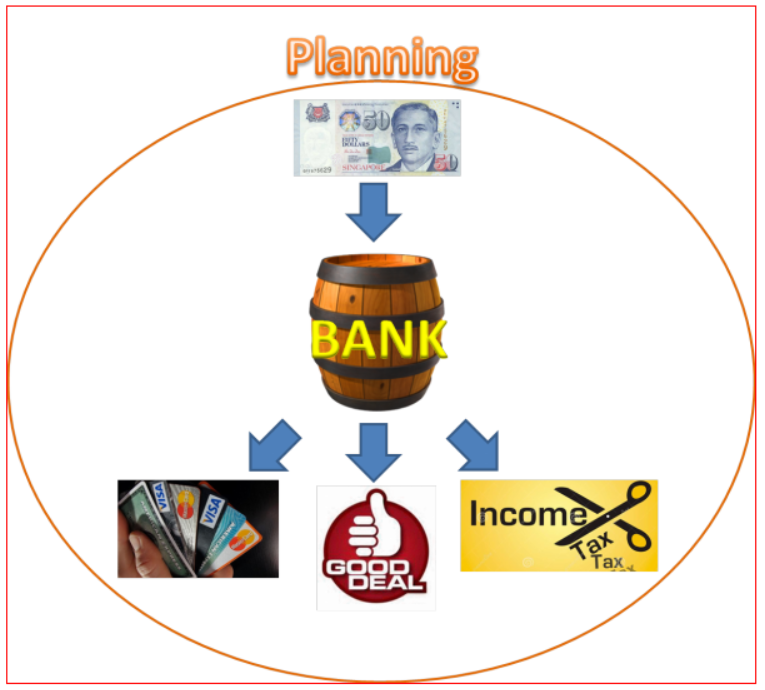
We set out 3 strategies to build up our spare cash: (1) Planning for current & future needs, (2) Increasing cash inflow, (3) Reducing cash outflow. The moves sound rather straight-forward so the actual challenge lies in the process of implementing them.
Planning for current & future needs
Planning is very important to us. It provides us with a clear direction to achieve our investment goals and allow flexibility to adjust our investment actions in line with the changing situation. Besides that, planning enables us to forsee key upcoming expenses so that we can prepare sufficient cash for them. One of our near-term expense is the HDB flat which should be ready by next year. In preparation for the renovation and household purchases, we have worked out a plan and budget to set aside sufficient cash before receiving our house keys.
Increasing cash inflow
Will you complain if you have more money inside your bank? Definitely not us! Our ways of gaining “extra” money are as follow:
(a) Choosing suitable savings accounts...
A savings account is the most basic investment building block for everyone. Hence choosing the right accounts will ensure that your incoming money has a “headstart” in getting itself invested. Similar to my co-writer EzHuat, I leverage on OCBC 360 to “passively” earn its interest rates. You can read about it from EzHuat’s post here.
(b) Enhancing our Pay-check!
My main source of income comes from my monthly pay-check. To get more money out of my pay check, I needed to have higher bonus and salary increments! I aim to achieve a relatively good performance each year so that I can have better bonus and improve my promotion opportunities. Enhancing my pay-check is however a double-edge sword. This is because the dreaded income tax rises in accordance with the salary increments. For my age group, this remains one of the most common and crucial source.
(c) Investing in Stocks
Our investments in Singapore stocks have achieved a return of 2.5 to 5% every year, across the past 6 year period. My calculations are based on my initial buying price and the amount of returns that enters my bank each year. Hence, the bulk of the cash inflow comes from stock dividends and from buying/selling shares during opportune times. I paid my fair share of "school fees" during my first 4 years due to poor investment choices; and was glad that over the last 2 years, my investment portfolio has improved on its rate of return. At this point, I am still actively shaping our investment portfolio by leveraging on the market conditions to build up a stronger base. I will share more about my investment experiences in future blog posts.
Reducing cash outflow
(a) Reducing cash outflow = saving even more!
My wife and I saved around 55-65% of our total annual income. We adopt a prudent mindset so that we can reduce our cash outflow in order to save EVEN MORE. Our concept is simple. If we are able to curb our urge to spend unnecessary, for example $1,000 on non-essential wants, we will be able to save $1,040. The logic is that we can use this extra $1,000 to buy stocks that yield 4% in dividends. So instead of losing the $1,000, we have $1,040 in our bank!
(b) Minimising Income Tax by preparing for your retirement
Income tax is a silent killer of our pockets. After happily receiving our salaries and bonuses, the most tense moment is to open up the income tax statement letter. This is the reason why we needed to find ways to minimise our income tax payment. One way is for us to top up our CPF Special Account (SA) with $7,000 cash each year. We see 2 main benefits to doing so. (1) Each top up increases our retirement fund by $280 due to the 4% interest rate for CPF SA; and (2) reduce our income tax payment by at least $380. So instead of paying income tax $380, we are gaining at least $660 each year. As our salary rises, we expect to gain more from the top up, especially when our salary crosses into the higher income tax % tier. The downside is that our cash will be locked in CPF until the withdrawal age which is currently 55 years old. And only then can we start to take out a portion of the cash from CPF.
(c) Maximising gain through multiple deal combinations
When making online purchases, we enhanced our rebates or discounts by combining multiple deals in a single purchase. One example is to go through referral websites to book my hotels from hotel providers; and using specific credit card to pay for the hotel bookings.
For my hotel bookings, I normally go through the following steps to minimise spending and/or maximise benefits from the purchase:
  • Using Shopback to select the hotel providers which offers the best hotel rates and cash back rebates. For example, the current promotion enables us to gain 6% cash back from Shopback for every successful Expedia booking/purchase.
  • Leveraging on credit card promotions to gain more value from hotel bookings. For example, the current promotion for Citi Premiermiles Visa card enables one to earn 6 Citi Miles per S$1 spent on Expedia.com; while for UOB One Card, they offer up to 50% savings on hotel bookings with Expedia + additional 10% off.

I hope that my sharing has provided some new tips and insights to what you can do to build up your spare cash. For a start, you might want to look into your own financial situation to determine whether my 3 strategies are applicable to you. Everyone has different needs, priorities and lifestyle so it is essential to tailor one that best suit you.


Together, let us all Go & Huat ah!
GoHuat