Showing posts with label Spare Cash. Show all posts

Tuesday, 4 July 2017

Do You Know the Meaning of Financial Freedom?

I want to be financially free!

This is probably the dream of everyone. What exactly is financial freedom? How do you achieve it?

By convention via a linear pathway, we were taught to study hard, get good grades, enrol into good schools, go to the University. After graduation, you find a good-paying job and then work work work to climb up up up the corporate ladder. 

After going through all the stressful periods farming your hard earned money, you then feel the urge to spend spend spend to satisfy your material needs, pamper yourself like royalty on holidays, buy bigger houses, cash in on the latest car models etc. After splurging on those big-ticket items, you then feel the pinch and obediently goes back to work to earn back the money again. Sounds familiar? 

Indeed, most people trade the bulk of their time for a paycheck. I'd term this a 'vicious cycle in perpetuity'. In other words, it is a self-imposed rat race. 

What is financial freedom?
As the name suggests, it means being free financially where you can maintain your lifestyle without worrying about a monthly paycheck, bills, food and entertainment expenses etc. 

Financial freedom is not merely about having more money. We have seen wealthy people fall from grace and become bankrupts, high-income earners who had to slog/borrow/beg to pay off debts or people who seems to be rich on the outside but actually poor on the inside.

On the flip side, we also witness ordinary people who earns modestly and lives simply. Despite that, they are able to do what they like. They work because they want to work, not because they need to work. They can afford a yearly holiday trip and some occasional splurges yet don't feel a pinch in their wallet.

Achieving financial freedom is about how you make use of money wisely with a peace of mind.

If money is not an issue, what would you do?
To understand financial freedom, you need to ask yourself the question above.

Would you travel around the world?
Would you start a new business?
Would you spend more time with your loved ones? 
Would you spend your time volunteering and help the needy? 
Or would you take on new hobbies?

Being financially free gives you these options. 

Take control of your life
To achieve financial freedom, here are some simple steps you need to take:
- Avoid debts
- Spend less than what you earn
- Invest your spare cash
- Generate multiple income streams 
- Set your financial goals. Know what you are working towards to
- The earlier you start, the better
- Be grateful with what you have, don't compare with others

What does financial freedom means to you?
Building wealth is just part of the equation. There are many more aspects in life to appreciate such as building your health, happiness, dreams.

For me, financial freedom is more than just financials. It means having the time of freedom to do what I want to do. Instead of material possessions, I prefer to have freedom to spend time with my loved ones. Having the freedom to change my career, start a new business, take some time off to gain new perspectives through meditation, pursue my passion and dreams, travel the world to learn more about what this splendid world has to offer and celebrate for. 

It’s not about what I choose to do, it’s about having the freedom to choose who I want to be or do what I want in my life fulfillingly and meaningfully. 

Go forth and plan your financial journey. Believe in yourself and you will reap the fruits of labour eventually. 


I would love to hear your definition of financial freedom! I would appreciate if you could leave your comments below :)

Cheers, 
EzHuat


Saturday, 4 March 2017

The case for cash + Some thoughts on Warren Buffett's letter


As many of you know by now, the DJIA topped 21,000 for the first time ever with Trump’s latest speech to the Congress resonating strongly with the market. The speech offered slogans, few detail, yet the market keeps charging ahead. Strange world, isn’t it? Naysayers have stayed on the sidelines waiting for a correction to come, yet they are getting left behind in the dust.

Source: Google images

There’s a theory going around that there’s just too much cash lying around waiting to be deployed, so people are just looking for reasons to buy. True or not, such mentality effectively pushes investors towards owning assets at virtually any price, which is surely nonsensical. 

What’s wrong with cash anyway? True, it generally has a zero expected real return. But at least there is a near certainty around that expected return, which sometimes is more attractive than the highly uncertain expected real returns on offer when alternatives are overvalued. It is beginning to feel like one of those times.

There are some pointers that I wish to share from Warren Buffett’s latest shareholder letter, which I finished reading a couple of days ago. There are many valid points that he made, but let's take a look at the top three for me:

(Admittedly, this is the first of his shareholder letters that I’ve read in detail. As I look to improve my knowledge as an investor, I plan to read all of the rest soon because it is truly as insightful as it has been said to be.)


1. “Of course, a business with terrific economics can be a bad investment if it is bought at too high a price.”

Reiterates what I just mentioned above. I know there is a lot of literature on this. Everyone wants to buy low and sell high, but it’s easier said than done. I’ve had my fair share of pitfalls too. Two things that I learnt I should have: (1) Discipline - stop that itchy finger! (2) Cash. Lots of it. Cash has one important endowment which is too frequently unrecognised: a hidden optionality derived from its relative stability. In other words, the holder of cash has an effective option to purchase more volatile assets if and when they become cheap. 

Speaking of cash, OCBC 360 is facing new changes (again) effective 1 April. Seems like the bank wants to further increase the deposit base and shift more into the revenue-generating products. Read Ezhuat's post about it here.

2. “Too many managements – and the number seems to grow every year – are looking for any means to report, and indeed feature, “adjusted earnings” that are higher than their company’s GAAP earnings.”

Eeeks, I really do hate it when I see the word “adjusted”. Because then I have to find out what has been adjusted, why they were adjusted, and more often than not there is not enough information (especially for private companies). Coincidentally, I had been reading through the prospectus of an F&B company earlier in the week and was quite disturbed (more like irritated) when I realised that the section on financials is littered with the word “adjusted”.

Look at this:


Whut? Had a headache immediately.
“Two of their favorites are the omission of “restructuring costs” and “stock-based compensation” as expenses.”
Hear, hear! Look at these adjustments to EBITDA of the same company:


Ok to be fair, the company had just made an acquisition, hence the acquisition costs and restructuring and integration costs etc. BUT that’s precisely the company’s entire business strategy. For growth, it acquires underperforming units from its competitors and refurbishes, converts, and integrates them into its own brands. They have such costs constantly, every single year, so obviously earnings should fully reflect them. The same goes for every acquisitive company, including Berkshire:
“Berkshire, I would say, has been restructuring from the first day we took over in 1965. Owning only a northern textile business then gave us no other choice. And today a fair amount of restructuring occurs every year at Berkshire... We have never, however, singled out restructuring charges and told you to ignore them in estimating our normal earning power. If there were to be some truly major expenses in a single year, I would, of course, mention it in my commentary... But, to tell owners year after year, “Don’t count this,” when management is simply making business adjustments that are necessary, is misleading. And too many analysts and journalists fall for this baloney."

3. “At Berkshire, we never count on synergies when we acquire companies.”
This comment appears to be made in passing as Warren Buffett talked about one of his favourite businesses. It struck a chord with me, because I have a case in point regarding promised synergies.

There is this food retail company in some part of the world which, a few years ago, acquired a food retail company in a neighbouring country, touting massive synergies from cost rationalisations and whatnots. Investors lapped it up, provided generous financing, and patiently waited for the magic to happen. Fast forward to now, the touted synergies still have not been realised, business is deteriorating at the acquired company because of intense competition, the acquirer is spending more than ever on the acquired in order to compete, debt load is massive with upcoming maturities, and worst of all the management has problematic communication which leaves investors second-guessing.


The market, of course, has gotten impatient and the company is now being punished. Bond prices came down probably about 30 points or so within a month.

Would love to write more, perhaps on how Warren Buffett humbly admits his misjudgments, how he gives his stamp of approval for low cost index funds, or how there seem to be subtle allusions to Trump (maybe I read too much into it), but I shall leave you with this:

“Moreover, the years ahead will occasionally deliver major market declines – even panics – that will affect virtually all stocks. No one can tell you when these traumas will occur – not me, not Charlie, not economists, not the media. Meg McConnell of the New York Fed aptly described the reality of panics: “We spend a lot of time looking for systemic risk; in truth, however, it tends to find us.” 

Good luck in the markets!


Cheers
Yolohuat

Wednesday, 1 March 2017

Will you continue to be loyal to the revised OCBC 360 Account?

When I was in the midst of work today, I received an SMS from OCBC informing that there will be changes to the OCBC 360 Account effective on 1 April 2017. I took a quick glance and was kind of disappointed with the so-called 'enhancements'.

In one of my posts, I blogged about the OCBC360 on What’s Next After Savings? This was the account which helped to kickstart my investment journey. With the upcoming revised changes to the interest rates, is it still worthy to put your funds in this account? Let’s delve deeper.


With effect from 1 April 2017, OCBC will be making five changes to the OCBC 360 Account.

Table 1: Comparison on upcoming change to OCBC 360 Account w.e.f. 1 April 2017

Current
New
Balance cap to earn bonus interest under OCBC 360 Account
$60,000
$70,000
Salary bonus
- Credit a minimum monthly salary of S$2,000 through GIRO
1.2%
No change
Payment bonus
- Pay at least 3 unique bills with your OCBC 360 Account
0.5%
0.3% (To qualify, pay at least 3 bills totalling at least S$150)
Spend bonus
- Spend a minimum of S$500 across your OCBC Credit Card(s)
0.5%
0.3%
Save bonus

Earn 1% per year on your incremental balance
Earn 1% per year on the first S$70,000 if account balance is ≥S$200,000
Wealth bonus
1%
Up to 1.2%
Base interest
0.05%
0.05%

With the above changes, how will it impact my current funds sitting in the account?

In my situation, all the changes will impact me except Weath Bonus as it is not applicable to me because I did not purchase their insurance product.

Let’s do a comparison assuming I have S$70,000 sitting in OCBC 360 Account under the revised scheme and fulfilled the salary, payment, spend and save bonuses.

Table 2: Comparison of Interest Earned

NEW
CURRENT

Interest Earned p.a. for $70,000
Interest Earned p.a. for $60,000
1.2% Salary Bonus
$840
$720
0.5% Payment Bonus

$300
0.3% Payment Bonus (revised)
$210

0.5% Spend Bonus

$300
0.3% Spend Bonus (revised)
$210

1% Save Bonus (revised)
N.A.
Assuming there is no increment
0.05% Base Interest
$35
$30
TOTAL (indicative)
$1,295
$1,350

In the table above, it is clear that I will earn $55 less under the revised changes. Moreover, I would have earned more interest under the existing Save Bonus if there are any incremental balances from the previous month’s balance contributed by my monthly salary which I did not reflect in the table.

For the Payment Bonus, you need to ensure your 3 bills total up to at least $150. There is no cap currently. However, I believe this should be easily achieved for most working adults.

If I continue to keep my funds in the revised OCBC 360 Account in Table 2, I will only get to earn 1.85% interest per year, down from 2.25% currently. On the other hand, I am sure there are many other better fixed deposit accounts which you can earn more than 1% with $200,000 rather than park it under OCBC 360 Account for 1% on the first $70,000. That means the balance $130,000 will be idling in the account and only accrue a miserable 0.05% base interest.

While OCBC calls it an ‘enhancement’, I seem to interpret that they telling us that the good O’ days of OCBC 360 Account is going to be over soon :(

Maybe it’s time to search for other better savings account now.

Will you continue to pledge your loyalty to OCBC 360 Account? Feel free to share your views as different people have different savings strategies :)

Cheers, EzHuat

Related posts:


Sunday, 26 February 2017

Recommending stocks can be tough, but so are You!


I often read about people seeking stock recommendations on Facebook or asking about the stocks that are suitable for buying in. For me, this is really a tough question to answer well as it usually involves some background understanding of the investor.
You might already be aware that my investment style is primarily based on “Global Trends” + “Fundamental Analysis”. This means that I spent a lot of time analysing & keeping myself updated of the global trends as well as to run through company financial reports every now and then. Boring right? If you have read my earlier post, I made several poor investment decisions in the past and these had resulted in a lot of stress for myself. This is the main reason why my first investment advice is to only invest with your spare cash. In case if you are interested, you can read about how I built up my spare cash too.
So, Why is it so tough to provide stock recommendations?
Because every share purchase carries a level of risk and it is important for the investor to understand whether this risk fits their investment profile before considering whether they should buy it.
Take for example, if a 80 year old retiree asks me what shares should he buy with his spare cash, I will be very curious WHY he wants to buy in the first place. For his age, it might be more practical to put his money into the bank or into short-term fixed deposit rather than taking on such a high risk to buy shares, isn’t it?
But we still can ask for recommendations, right? Well, maybe. But I am unsure of its usefulness unless we are just trying to find out what other people are considering or have considered at that point. My view is that most stock recommendations will no longer be valid once the market or business conditions changes; which might come quickly and suddenly. Another reason for myself is that I based my target prices for buying and selling on a set of criteria so my definition of “good buy” might not necessary be the same for others. Likewise many investors used different yardstick to define a “good stock to buy/sell/trade/invest”.
Is there that much things to learn before investing in a product? For me, the answer is a clear “Yes!!”. The risk of losing money will always be there when we decide to invest in a product. This is why we need to put in effort to learn about our investment product instead of only asking for recommendations. Many of us might find this to be really tough since we usually lead a relatively busy life out there. But I am sure that my readers here are tough enough to find time to put in the extra mile for your own investment journey. Maybe a bit of motivation from Mr Warren Buffett might come in handy here. :)

Recommending stocks can be tough, but so are You! 
Together, let us all Go & Huat ah!
GoHuat

Related Posts

Saturday, 22 October 2016

GoHuat explains.. “How did I build up my spare cash?”


In my first post, I explained about my foremost investment guiding principle - ONLY INVEST WITH MY SPARE CASH. The 2nd question will be - “How did I build up my Spare Cash”. In this post, I shall share more about how this can be achieved.
Making Financial Decisions with my Spouse
As my readers might have known from my profile, I am happily married, so a lot of family decisions are made after discussing with my wife. These routine discussions enabled both of us the chance to present and explain our viewpoints openly on our near-term financial situation and long-terms goals. We also identified common directions and goals to work towards to enable us to retire early. For us, a conversation on finance matters is a key building block for our marriage. I am grateful that she has been ever supportive, always willing to listen and share her perspectives. She is also my greatest pillar of support whenever I want to explore new areas to work on. So readers out there, we urge you to engage your spouse actively for all your investment matters too!
In general, we believe in saving and investing well when younger; so that we can reach our investment goal faster. This might sound contradictory but we also see the importance of spending on travelling and socialising to uncover and expand our perspectives of foreign countries and cultures. Thus, it is necessary for us to plan and maintain a suitable balance between saving for our goal and spending in self-development.
Strategies to build up spare cash


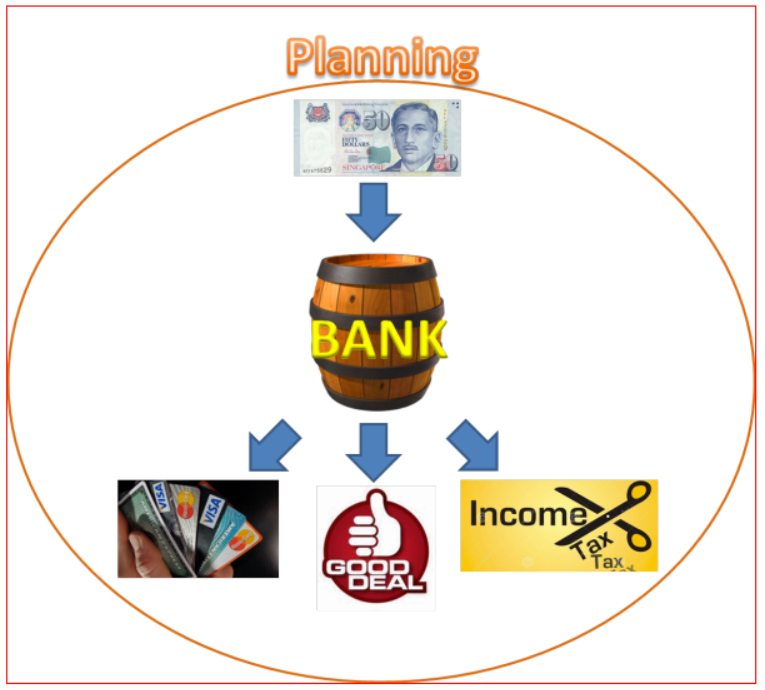
We set out 3 strategies to build up our spare cash: (1) Planning for current & future needs, (2) Increasing cash inflow, (3) Reducing cash outflow. The moves sound rather straight-forward so the actual challenge lies in the process of implementing them.
Planning for current & future needs
Planning is very important to us. It provides us with a clear direction to achieve our investment goals and allow flexibility to adjust our investment actions in line with the changing situation. Besides that, planning enables us to forsee key upcoming expenses so that we can prepare sufficient cash for them. One of our near-term expense is the HDB flat which should be ready by next year. In preparation for the renovation and household purchases, we have worked out a plan and budget to set aside sufficient cash before receiving our house keys.
Increasing cash inflow
Will you complain if you have more money inside your bank? Definitely not us! Our ways of gaining “extra” money are as follow:
(a) Choosing suitable savings accounts...
A savings account is the most basic investment building block for everyone. Hence choosing the right accounts will ensure that your incoming money has a “headstart” in getting itself invested. Similar to my co-writer EzHuat, I leverage on OCBC 360 to “passively” earn its interest rates. You can read about it from EzHuat’s post here.
(b) Enhancing our Pay-check!
My main source of income comes from my monthly pay-check. To get more money out of my pay check, I needed to have higher bonus and salary increments! I aim to achieve a relatively good performance each year so that I can have better bonus and improve my promotion opportunities. Enhancing my pay-check is however a double-edge sword. This is because the dreaded income tax rises in accordance with the salary increments. For my age group, this remains one of the most common and crucial source.
(c) Investing in Stocks
Our investments in Singapore stocks have achieved a return of 2.5 to 5% every year, across the past 6 year period. My calculations are based on my initial buying price and the amount of returns that enters my bank each year. Hence, the bulk of the cash inflow comes from stock dividends and from buying/selling shares during opportune times. I paid my fair share of "school fees" during my first 4 years due to poor investment choices; and was glad that over the last 2 years, my investment portfolio has improved on its rate of return. At this point, I am still actively shaping our investment portfolio by leveraging on the market conditions to build up a stronger base. I will share more about my investment experiences in future blog posts.
Reducing cash outflow
(a) Reducing cash outflow = saving even more!
My wife and I saved around 55-65% of our total annual income. We adopt a prudent mindset so that we can reduce our cash outflow in order to save EVEN MORE. Our concept is simple. If we are able to curb our urge to spend unnecessary, for example $1,000 on non-essential wants, we will be able to save $1,040. The logic is that we can use this extra $1,000 to buy stocks that yield 4% in dividends. So instead of losing the $1,000, we have $1,040 in our bank!
(b) Minimising Income Tax by preparing for your retirement
Income tax is a silent killer of our pockets. After happily receiving our salaries and bonuses, the most tense moment is to open up the income tax statement letter. This is the reason why we needed to find ways to minimise our income tax payment. One way is for us to top up our CPF Special Account (SA) with $7,000 cash each year. We see 2 main benefits to doing so. (1) Each top up increases our retirement fund by $280 due to the 4% interest rate for CPF SA; and (2) reduce our income tax payment by at least $380. So instead of paying income tax $380, we are gaining at least $660 each year. As our salary rises, we expect to gain more from the top up, especially when our salary crosses into the higher income tax % tier. The downside is that our cash will be locked in CPF until the withdrawal age which is currently 55 years old. And only then can we start to take out a portion of the cash from CPF.
(c) Maximising gain through multiple deal combinations
When making online purchases, we enhanced our rebates or discounts by combining multiple deals in a single purchase. One example is to go through referral websites to book my hotels from hotel providers; and using specific credit card to pay for the hotel bookings.
For my hotel bookings, I normally go through the following steps to minimise spending and/or maximise benefits from the purchase:
  • Using Shopback to select the hotel providers which offers the best hotel rates and cash back rebates. For example, the current promotion enables us to gain 6% cash back from Shopback for every successful Expedia booking/purchase.
  • Leveraging on credit card promotions to gain more value from hotel bookings. For example, the current promotion for Citi Premiermiles Visa card enables one to earn 6 Citi Miles per S$1 spent on Expedia.com; while for UOB One Card, they offer up to 50% savings on hotel bookings with Expedia + additional 10% off.

I hope that my sharing has provided some new tips and insights to what you can do to build up your spare cash. For a start, you might want to look into your own financial situation to determine whether my 3 strategies are applicable to you. Everyone has different needs, priorities and lifestyle so it is essential to tailor one that best suit you.


Together, let us all Go & Huat ah!
GoHuat


Wednesday, 19 October 2016

What’s Next after Saving?

It is widely known that banks in Singapore give very meagre interest rates for fixed deposit and savings accounts. Especially for fixed deposit accounts, most of them require a minimum placement with considerable tenures ranging from 12 months to 36 months or more. That means that if you ever withdraw any amount before the maturity period in the event of emergency, you will lose the privilege to accrue the bonus interest. 

Instead of dumping my spare cash in fixed deposits (I used to put my money in POSB savings account), there are many other better savings accounts available in the market to help increase your savings.

In my second post, I will share what I’ve done to accrue more interest without being tied down by the fixed deposit tenures. 

Pardon if my post might be a bit outdated since many financial bloggers would have already shared about the various savings accounts. For the benefit of my readers who are not aware of OCBC 360 account, this post is for you J

I applied for the OCBC 360 account to take advantage of the higher interest rates. If you’re keen to find out more, do check out this website: https://www.ocbc.com/personal-banking/accounts/360-account.html.


OVERVIEW OF OCBC 360 ACCOUNT
When I signed up in May 2014, the package was more attractive as I managed to accrue at least 3.05% interest per year. It lasted for about a year before it was revamped. My hunch is probably due to the overwhelming popularity so there wasn’t much impetus for them to offer such good benefits. Nonetheless, the make-over still rank them as one of the best in the market presently with a couple of enhanced features.


Based on the table above, I stand to gain 1.2% as along as my employer diligently credits the monthly salary into the account. With a base interest of 0.05% per year on my entire account balance, I would have pocketed at least 1.25%. This interest rate already triumphs many other fixed deposits.

It was easy for me to fulfil the second criteria to pay any 3 bills with the account. That’s another 0.5%. Together with the first criteria, I have earned at least 1.75% interest per year.

The credit card which I signed up was OCBC Frank Card together with the opening of OCBC 360. Most of the time, I managed to clock just above $500.

As I am already sufficiently insured, I did not purchase any OCBC financial products.

The last criterion is based on any incremental account balances from the previous month’s balance. Since I am gainfully employed, I’d received monthly salary which progressively increases my account balance. In addition, this bonus interest will be paid on incremental account balance of up to S$1,000,000!

With the first three and last criteria met, I would have reaped more than 2.25% interest per year effectively!

You can use the interest calculator available on the website to calculate the potential interest you can get. If you have a balance of $60,000 for a period of 12 months (less the purchase of financial products), you can potentially earn an indicative amount of $1,375.56 for a year! This is as good as investing in the stock market so long as you satisfy the criterions adequately.


And if you purchase any eligible OCBC financial product, you can earn an indicative amount of $1,986.96 a year!


If you are building up/already have up to $60,000, you can consider applying for OCBC 360. It surely beats any fixed deposits out in the market!

UPSIDE
  1. As cashflow is important to me, I like the fact that I can move my money as and when I want without fretting that I might lose out on the bonus interest of a fixed deposit as long as I don’t withdraw a huge sum.
  2. Good for those earning more than $2,000 per month and need to pay off at least 3 bills. I presume most of the working adults can easily satisfy these two.
  3. The Frank credit card served me well as they offer an attractive rebate of up to 6% for online purchases. This largely benefitted me for my travel expenses, movie tickets, and occasional purchases via online platforms such as Groupon. If you are keen to find out more about Frank credit card, you may visit the website at http://www.frankbyocbc.com/products/cards/credit-card/ (do take note of the fine prints!)
  4. My account balance grows faster based on an effective interest rate of 2.25%.
  5. I can withdraw money freely without worrying that I might lose out on the bonus interest, albeit I will accrue lesser interest if the account balance is lower at the end of the month.
  6. The interest is paid on a monthly basis. Better than the typical quarterly or half-yearly dividends you receive in stock market!


DOWNSIDE
  1. The bonus interest is only valid for the first $60,000 of the account balance.
  2. I need to spend at least $500 monthly to be eligible for the 0.5% bonus interest. There are instances where I did not meet this criterion simply because it is not practical to spend money intentionally just to accrue the 0.5% interest. On the months which I do less of the transactions, I just earn less bonus interest. 


To me, it is pretty clear that the upside outweighs the downside. Due to the popularity of OCBC 360, I reckon it caught the attention of other banks that subsequently rolled out relatively similar products such as the following:


If you’re a disciplined saver and your stash of cash is still roosting in a fixed deposit nest hoping it can lay more ‘golden eggs’, think again. 

It’s time for you to take advantage by leveraging on any of the above savings accounts.

With all being said, it is pertinent that you always do your own due diligence to assess your own financial needs. Once you make the first move, you will surely be rewarded at the end of the day! Feel free to share if you have other recommendations.

As always, it can be easy to huat!

Good luck! :D

Cheers,

EzHuat

[UPDATE: Please refer to blog post http://triplehuat.blogspot.sg/2017/03/will-you-continue-to-be-loyal-to.html for revision to OCBC 360 Account w.e.f. 1 April 2017]