Showing posts with label Stocks. Show all posts

Friday, 30 June 2017

YoloHuat's 1H 2017 Report Card

The first half of the year is almost gone and doomsday never arrived. Instead, stock prices continued to make new highs. A parking spot in Hong Kong gets sold for a record HK$5.18 million (US$664,300), costing more than some Hong Kong homes - and housing there is already the least affordable in the world. A new 100-year Argentina (one of the most regular defaulters in history) sovereign bond apparently was 3.5x oversubscribed. Investors simply do not believe in the Fed’s hawkish zeal, and so the party continues.

Anyone who remained invested in the market should have seen pretty decent returns so far this year. I thought I was totally nailing it, until I generated some numbers to see how I stack up against the index:

My report card (as of 28 June 2017):


The blue bar is the XIRR of all cash flows from Jan until 28 June for my portfolio (I'm slightly bemused that it's such a nice round number), while the red bar is the annualised year-to-date return of the SPDR STI ETF. It is indeed disappointing to be lagging the index, and after some scrutiny I attribute it to poor timing - buying in too early. Clearly this result explains why there has been raging debate over active vs. passive investing.

With hardly any yield on cash and limited avenues to generate returns, for the common retail investor at least, this long upcycle has likely resulted in most of us being long and overweight equities. The slow nominal growth however, induced us to complement it with an income focus (thus the popularity of REITs and dividend stocks). A quick browse through of the local finance blogs and sell-side research reaffirms this view - and leads me to wonder if everyone has the same positions. In fact, it’s my biggest worry now, especially with the pervasiveness of passive index investing. Downside has actually risen, as any sell-off would lead to everyone trying to get out of the same door at the same time. (Meanwhile, upside is limited with everyone having bought already.) You may argue that you are in for the long term and will ride through the cycles, but how confident are you that you will not hit the panic button when shit happens, especially when money can be pulled out with only a few clicks? To be honest I’m not that confident myself. Plus, my emotional control hasn't really been put to the test yet. I draw comfort though from the knowledge that I do not depend on my portfolio for liquidity. Do read this post on spare cash by GoHuat if you haven't.

Cheers
YoloHuat  


Sunday, 14 May 2017

Confidence in Ascendas Hospitality Trust Paying Dividends?

I first took note of Ascendas Hospitality Trust following their failure to sell their business. At that time, I was  looking for REITs/TRUSTs with business operations across the Asia-Pacific region, instead of in Singapore only. My consideration for the hospitality sector is that Singapore was projected to have an increase in supply of hotel room over the next few years, and it is impossible to be certain whether more tourists would come to take them up.
Out of curiosity, I decided to go through AHT's financial statements. Besides having a good balance sheet, their exposure in Australia and Japan drew my attention as I believed both countries have the right business conditions such as low interest rate and then-depreciating currency. Moreover the share price was below my target buy price. Not difficult to guess what comes after that right? 😜
Here is an brief overview of AHT's business:
Credit: AHT 4Q FY2016/17 Financial Results Presentation
So how did AHT perform in FY2016/17?
Credit: AHT 4Q FY2016/17 Financial Results Presentation
Based on their 4Q FY2016/17 report on 11May, AHT have performed very well by clocking a record Distribution per Stapled Security of 5.68cents. Their Net Asset Value has also risen from S$0.85 in Dec 2016 to S$0.92 in Mar 2017.
 Credit: AHT 4Q FY2016/17 Financial Results Presentation

Credit: AHT 4Q FY2016/17 Financial Results Presentation
Net Property Income is an important indicator to determine a property portfolio’s profitability. I am interested to find out the breakdown of AHT's NPI by country, as the tourism business is geographical-dependent. 51% of AHT’s NPI comes from Australia and 29% from Japan. To this end, both countries have registered a rise in NPI of 12.9% and 24% respectively. 
Final Thoughts
Glad that my investment in AHT has gone well so far and I remained hopeful for more dividends to come in future. A key risk that I am monitoring closely are potential business disruptions such as AirBnB which has affected the business of traditional Japanese Inns and are gaining much popularity in Australia. Staying alert to the global trends remains important to me as these disruptions could snatch away our "lunches" really quickly!
Together, let us all Go & Huat ah!
GoHuat

Related Posts
Looking at REITS/TRUSTS for a Change..

Thursday, 11 May 2017

Rationalising Mapletree Logistics Trust ...


Mapletree Logistics Trust is one of the best performers in my portfolio. My interest in MLT lies in their well-managed business across the Asia-Pacific region and backing by a strong sponsor - Temasek. I managed to sieve out 5 key indicators from their 4Q2016 & FY2016/17 results which could be useful to note:
  • Business performance, in terms of available Distribution Per Unit, has increased by 0.8% Year-on-Year.
  • Increase in Net Asset Value from S$1.02 to S$1.04.
  • Aggregate leverage fell from 39.6% to 38.5%. This could potentially provide MLT with the capacity to borrow more to fund further acquisitions.
  • 81% debt hedged into fixed rates & 72% of income stream for FY17/18 hedged into SGD.
  • Slight rise in portfolio occupancy rate to 96.3% in Mar 17, from 96.2% in Mar 16.
My confidence in their recent acquisitions in Australia and Vietnam has been rewarded, as these properties have been fully leased and are contributing well to the overall Net Property Income. I also like MLT's strategy to divest the old warehouse in Toh Guan, given its limited potential for re-development into a modern facility. The money from the sale can then be reinvested in other warehouses with greater potential. Overall, I still find MLT's business to be well-managed and a quality investment. 
So what’s next? I saw this article on Colliers International for USA and thought that it could potentially serve as a guide for the future Asia-Pacific region.
 
Extracted from: Colliers International, Knowledge Leader
As the e-commerce in the Asia-Pacific region is expected to keep growing, my view is that this would likely to continue fuel the demand for warehouse spaces in the next few years.💪 What do you think?
Together, let us all Go & Huat ah!
GoHuat

Related Posts

Friday, 7 April 2017

5 Key Reasons for buying Singtel now


Over the past few months, share prices for my shortlisted REITs/TRUSTs have been rallying beyond my target buy price. And so, I decided to explore whether there are other potential shares that could also fit well into my overall investment strategy. After going through a long process of analysing several potential companies such as ST Engineering, Sheng Shiong, SGX, etc, I was rather glad to find Singtel to be a suitable fit and thought that it will be useful to share my 5 key reasons here.

Reason 1: Singtel’s Earnings & Net Asset per share have been on a steady up-trend over the last few years. While there are risks of increasing competition from the 4th telco (TPG) or companies with other disruptive technologies, my view is that these should not affected Singtel’s earnings much in the foreseeable future as the competitors will likely not be mature enough.

Source: Singtel


Reason 2: Singtel has sound & stable business fundamentals with high dividend payout at 60-75% of their Net Profit. Its current dividend yield is around 4.5% which is relatively high.

Source: Singtel

Reason 3: A key business risk - foreign exchange rate - has been relatively well-managed.

Reason 4: Looking ahead, I found Singtel’s investment in the 5G network to have a lot of business potential, especially with Singapore’s push to become a Smart Nation. The 5G network infrastructure should become an essential backbone in enabling faster and smarter connections - Internet of Things. All these would likely give Singtel a greater competitive edge over their rivals in the future.

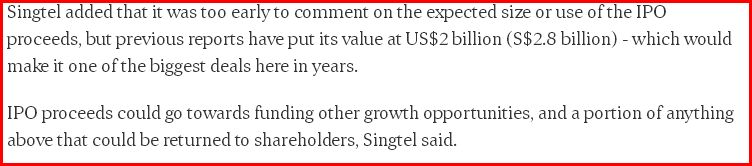
Reason 5: Singtel is preparing their fibre broadband unit NetLink Trust for an IPO before Apr 2018; which should translate to a much higher share price in near-term or higher dividend pay-out. See extracts from Straits Times below: 


 Source: Straits Times

So what have I done?

Using both cash and CPF OA, I have made several rounds of purchase last month. Currently, Singtel forms around 7.5% of my cash portfolio and I am likely to buy more share in the next few weeks. 

Will the outcome be as what I have assessed above? I certainly hope so, but we will never know until it truly happens! 

Together, let us all Go & Huat ah!
GoHuat


Tuesday, 28 March 2017

Why should we ever use our CPF OA for investment?


Whenever I bring up the topic of investing the money in my CPF Ordinary Account (OA), my dad will always remind me that the primary purpose of our CPF is to support our retirement purposes; and I should consider very carefully if I decide to use them to invest in stocks/bonds/gold. Well, he is not wrong and there is little reason to disagree with him. The present CPF OA’s 2.5% interest rate is actually not too bad and most importantly, it is risk-free. So why should we ever use our CPF OA for investment?
Our triggering point came last year when it dawned on my wife and I that all of our CPF OA will soon be wiped out by HDB. We started to ask ourselves whether this move will fit well into our investment strategy. A few questions sprung to our mind:
· What is the purpose of the money in our CPF OA? I think this is the most fundamental question that we should ask ourselves. If we are not convinced, we would just let HDB flush away our CPF OA as clearing our loans should be the safest bet, right? Well, one potential use-case is for the purchase of a 2nd property in future. The money in CPF OA would be useful in providing extra firepower to our “cash-on-hand” to fund the purchase.
· What are my options to prevent our CPF OA from being flushed out? Based on my research, they include: (Option 1) Transferring the money from CPF OA to CPF Special Account (SA). (Option 2) Use the CPF OA money to invest in stocks, bonds, gold and/or etfs.
· What are the pros/cons of Option 1? The SA account yields a higher, risk-free 4% interest rate return. This interest rate is much higher than the 2.6% HDB loan rate which means that I could earn an additional “1.4%” and more each year. However, in the near term, I might have to use some “cash-on-hand” each month to cover the loan if my monthly OA contribution is unable to. Another consideration is that this money could only be withdrawn around 20 years later.
· What are the pros/cons of Option 2? This option will allow us to hold our money in CPF OA so that when the opportunity arises, we can use it for our future purposes. The downside is that there is a potential likelihood for the OA money to get stuck in a paper-loss situation. We will also have to take on the investment risk fully by ourselves instead. 
So what is our final decision after all these brainstorming?
We decided to adopt a hybrid approach using Option 1 and 2. The current interest rate for HDB Loan is 2.6% and I believe that it is not too difficult to achieve an investment return that is higher than that. My aim is to at least achieve a minimum of 3% returns per year in order to be higher than the 2.6% loan rate after deducting all transaction cost. I focused our portfolio on 2 strong companies - Singtel and OCBC so that even if we get ourselves into a paper-loss situation, their annual dividends should still be stable enough to maintain throughout. 
Over the past weeks ago, my wife and I have purchased and are adding more Singtel, OCBC which we think are suitable at this point; and also STI ETF shares into our CPF portfolio. Once we have used up our CPF OA until its remaining S$20K, we are likely to transfer a portion of the S$20K into SA; after taking into consideration all other payments such as the remaining 5% downpayment (staggered downpayment scheme).
Moving forward, we are keeping a close watch on the HDB loan rates. This is important as any drastic increase could potentially change our approach, though we believe that the chances of this happening should be relatively low. Still, no one can ever predict the future and we should just get ourselves prepared.
Hope you enjoyed this sharing and so, What will your approach be if you are in a similar situation ?
Together, let us all Go & Huat ah!
GoHuat

Related Posts


Friday, 23 December 2016

The Year Ahead


The eventful year is coming to a close soon. Kudos to everyone for surviving the rollercoaster ride! President-elect Donald Trump was a total game changer indeed, and we are now facing a stronger US dollar, higher commodity prices, higher bond yields, and lower gold prices. Even the US Federal Reserve has become more hawkish.


For the past 1.5 months or so, the growth strategy has continued to fire on all cylinders and pushed equities in the US up by nearly 6%, while the STI rallied by 5% to ~2,960 within a month of the elections (although it has since retraced by about half of that move). There was a comment in a Bloomberg News article that if one closed his eyes and bought into the market at the start of 2016 and only opened his eyes again at the end of the year, he would never have guessed that events like Brexit and Trump happened. Lol.


With still so little concrete information besides who won the elections and the appointments for the various posts in the administration, one does wonder though whether markets are getting ahead of themselves (especially for us folks in this part of the world - Asian countries are running a $401 billion goods trade surplus with the US this year, according to the US Census Bureau). For investors who did not join the growth trade immediately after the elections, this translates into the question of whether it is now too late to join in.


Some food for thought:


  1. Singapore is facing a period of slower growth as it attempts to reorient its economy. GDP growth is trending at about 1%, supported by government spending. 3Q GDP growth was revised upwards to 1.1% year-on-year from the advance estimate of 0.6%, but still a slowdown from 2% in 2Q. The services industries, which together account for around two-thirds of GDP, entered a third consecutive quarter of contraction, led by the external-oriented sectors. The financial and insurance services sector underwent its first y-o-y contraction since the global financial crisis. Singapore banks continue to grapple with a credit cycle. In the property market, concerns remain over the overcapacity in office space, falling retail sales, and a residential market correction.


  1. Will MAS come in to support? The latest meeting saw the central bank keeping on hold as it believes its past policy easing will continue to filter through to the economy in the quarters ahead. It probably can ease further if growth does not pick up as expected, but this may get tricky against a backdrop of US rates and the dollar continuing to rise. Furthermore, note that with higher US rates and dollar, Asia (including Singapore) may see reduced support from foreign inflows.  


  1. How high can the US Treasury yields go? Market expectations of two hikes in 2017 proved to be too conservative and the outcome of the Fed’s December meeting, with median projections of three hikes next year, caused some repricing. One of the Fed’s most hawkish policy makers has even warned that the Fed may have to raise rates more than three times next year. During the 2013 taper tantrum, the 10-year yields rose to 3%. The US labour market is much tighter now than it was in 2013. Seems like there’s more room to go?


  1. Eurozone equities have lagged significantly year to date and suffered from big outflows. The Eurozone business cycle is also at a much earlier stage than the US one. Valuations may therefore be looking cheap, but the election calendar going forward is heavy. Trump’s victory could just be the start of the rise of populism, and this could potentially throw markets off by a greater extent.


Mentioned Europe because I’m considering getting some exposure likely via a low cost ETF. Anyway, I’m generally still on the sidelines, didn’t participate in the rally and hence am more cautious now on the trends going forward. Would be looking for cues on policy direction from the new US administration next year. Plus, I may need some extra cash for a new flat sometime next year (maybe - haven’t even gotten queue number yet), so not much dry powder.


In November I added Singtel and Aims Amp Capital Industrial REIT. For Singtel, being a blue chip name that everyone likes, I needn’t explain more right? Added on the dip during the month, though it was still an average up. I’m also a happy subscriber because now my mobile phone bills are lower by ~$20 per month after I switched to their SIM-only plan (I know this is not good for ARPU though… :p). Aims Amp: averaged down my cost when the price came off after the lower 3Q DPU. I think concerns about the sector are well flagged and management has been pretty proactive. This month, I took profit on Apple, which I held for trading (total return ~24% in SGD terms - some dividends, some unrealised FX gains, mostly capital gains). It rose further after I sold zzz. Anyway, will be keeping the USD proceeds for the next trade.


Merry Christmas and happy 2017 in advance!


Regards
Yolohuat

Sunday, 18 December 2016

A Penny for Your Thoughts on Opportunities related to Singapore-Kuala Lumpur High Speed Rail Project


Singapore-Kuala Lumpur High Speed Rail Project
Last week, the Prime Ministers of Singapore and Malaysia announced one news that caught my attention: Construction of the High Speed Rail (HSR).
The HSR project will have 2 terminal stations in Jurong East and Bandar Malaysia; as well as stations in Iskandar Puteri, Batu Pahat, Muar, Ayer Keroh, Seremban, Putrajaya. It is slated for completion in 2026. The project would have at least 3 joint tenders by both countries. The HSR is expected to cut travel time between Singapore and Kuala Lumpur to 90 minutes. The Customs, Immigration and Quarantine facilities will be co-located at Singapore, Bandar Malaysia and Iskandar Puteri.
During the project HSR annoucement, I took note of 2 key lines from the Prime Ministers’ speeches:
“HSR line will transform the way the two countries interact, socialise and do business, for the better.”
“With hundreds of thousands of people crossing the causeway each day, security was one of the major issues that the two countries discussed before they proceeded with the HSR project.”
Master Plan for Jurong Lake District
Another important information is that URA has already started stage 2 of their request for proposal in Sep 2016, to develop a master plan for the Jurong Lake District. URA also announced their vision for the district to be a ‘District of the Future’ and our second Central Business District (CBD).
So.. How do the Above Points Add Up?
Bringing the above points together, there are many business considerations that are directly or indirectly affected by the projects; and these are what we, as investors, should think about.
Potential Outcome in the Short-Term
In the short-term, the HSR should generate more infrastructure and construction work for both countries. My current view is that 5 main industrial sectors might benefit from the project: (i) Engineering (Rail operator) is likely involved in the construction as they can share their operator experiences to enhance the rail design; (ii) Engineering (Civil/Electrical Engineers) should be involved in the infrastructure such as electrical cables, physical tunnelling etc; (iii) Engineering (Network Providers) is likely to be involved in setting network equipment and laying of network cables; (iv) Engineering (Security) – a major issue for both countries, will require security equipment to be installed; (v) Banks would need to provide loans to all companies involved in the development.
Some food for thought: 
Are there other industrial sectors that you think might benefit from the project? 

Which companies within these mentioned sectors would have the capability to take part in the tenders? 

Which aspects of these companies should you pay attention to for you to make an investment decision?
Potential Outcome after post-HSR completion
After the HSR is ready for operation, I felt that the social trends in both countries would change too. For discussion, my post will focus on 2 aspects: Lifestyle and Properties.
Lifestyle: Currently, both countries are largely connected via Johor Bahru, through the 2 causeways at Woodlands and Tuas. I believed that the HSR would greatly increase the flow of traffic between the two countries. More Malaysians from other parts of Malaysia could travel to Singapore to work. Singaporeans might visit Malaysia more often for shopping, if the prices in Malaysia are indeed much cheaper than in Singapore.
Some food for thought: 
Amidst all these changes in lifestyle, are there any companies/businesses that would be well-positioned to leverage on the increase in spending on living necessities, shopping, weekend getaways, etc in both countries?
Properties: I believed that Jurong CBD would focus on the development of industrial and commercial properties. Residential properties that are near the HSR train stations should experience greater buying demands. More Singaporeans might consider buying a residential property in Malaysia for investment; or for stay as the cost of living is still lower there. In Singapore, more Malaysians might consider renting houses in the Jurong area to minimise their travel to the Jurong CBD.
Some food for thought: 
How will Jurong’s property landscape be transformed by the Jurong Lake District and HSR? 

What will be the potential impact to existing industrial, commercial and residential properties in the region? 

Which companies/business would benefit from all the constructions and developments in Jurong?
My next step..
As the HSR project is still in the preliminary phase with no contracts signed yet, I am likely to monitor its developments closely first instead of buying into any rumoured companies.
I hope that after reading this post, it has helped to spur up some thoughts in you. Feel free to share your thoughts with us!
Together, let us all Go & Huat ah!
GoHuat


Related Posts

Information Sources
[1] Singapore, Malaysia sign bilateral agreement for High-Speed Rail project
[2] Singapore-KL high-speed rail deadline ‘ambitious but achievable’


[3] Singapore, Malaysia sign historic high-speed rail deal
[4] Singapore-JB Rapid Transit System to be linked via high bridge 
over Straits of Johor
[5] Malaysia inks deal on high-speed rail
[6] Strong industry interest in Jurong Lake District Master Plan
[7] Components of Conceptual Master Plan and Design for stage 2 of Jurong Lake District RFP

Friday, 16 December 2016

Using Target Price as a strategy to buy/sell stocks!


It was during a routine sharing among my fellow blog writers - EzHuat and YoloHuat that sparked off the inspiration for this post. I would usually ask or share with them my “Target Price” for the stocks that I am interested to buy/sell. It was only when YoloHuat mentioned that “Target Price” has helped her to stay disciplined; that I realised that this could be a good strategy to share with my readers too.
Motivation for adopting “Target Price” Strategy
At the start of my investment journey, I used to buy/sell whenever I think the price is right which is no different from betting on 4D or Toto. I wanted a more systematic approach in buying & selling my stocks instead of relying on “feeling”. After reading many investment books, my conclusion is that every stock has a value; and a price. Ideally, we should buy a stock with a price less than its value. So the first question is really “How do we assess the company’s value?”
Assessing Company’s Value
There are tons of literature out there to explain how we could assess a company’s value. Hence I would not want to go into the technicalities here. A point to note is that the type of indicator (i.e Price-to-Earnings ratio, Net Asset Value, etc) has certain limitations and might be dependent on the type or nature of the business. For example, Net Asset Value might be more relevant to assess companies which rely on assets as their main business model or income source. Such companies include property developers as their business model is dependent on their asset prices (i.e. land and property prices).
In my previous post, I shared that my current focus is to build up REITs/TRUSTs in my investment portfolio. Hence, over here, I shall share my current list criteria to estimate the value for REITs/TRUSTs: (1) Dividend yield is at least 7% return; (2) PE Ratio of 12 and below (with exception of MapleTree Logistic Trust as I assessed that their recent acquisitions could improve the ratio in future); (3) Net Asset Value at 80% and below; (4) Potential upside to its stock price by at least 10% based on ongoing and upcoming businesses in the coming years.
Setting Target Prices
Based on my above list of criteria, I tend to set target buying prices at around 10% lower than its value price. The current investment outlook is highly volatile and the market has passed the 7th year bull-run. This is one reason why I am carefully selecting the stocks that I would be willing to hold for the longer term. Regardless of the length of my investment time frame, my aim is still to sell the stocks when their selling price is at least 20% of the buy price, depending on the market outlook.
Beauty of “Target Price” Strategy
The “Target Price” strategy has served me well so far. Nowadays, I will only walk into a deal if the stock price meets my Target Price. In my view, the beauty of this strategy lies in its possibility to build up my own set of target prices based on my defined potential value. This would allow investors, who are more conservative, to set target buying price with greater margin of safety; so that their cash would leave their pockets only when the price is right.
Will the “Target Price” Strategy work for you?
There are just so many investment strategies and school of thoughts. My view is that it is important to see whether this strategy could fit well with your investment profile. Over the years, I have and am still improving on my investment skills as I gained more experience and knowledge.
I would love to hear your views on this too so feel free to share with me here!
Together, let us all Go & Huat ah!
GoHuat


Sunday, 13 November 2016

Is the current global outlook still favourable to investors?

Many people have been asking whether the current global outlook is still favourable to investors. There seemed to be endless happenings around the world that could drive world economies to the ashes. The American Presidential election results ended a few days back. The Quantitative Easing measures undertaken by the various central banks is still ongoing. The never-ending roller-coaster saga of the oil supply and price. China’s economy is still an uncertainty. The bull run in the stock market has already gone past the 8th year mark. Many European countries will be holding elections or referendums in the coming months. Despite the seemingly bleak outlook, my answer is still a Yes! to investing now.

Why Yes?

Most investors would know that it is almost impossible to predict the market as we will never know how the world will be like tomorrow. The best example is when the US Federal Reserve announced their intention not to raise interest rates across the past few meetings. Each time, the responses from the stock market rose or fall with seemingly no fixed pattern. As there will always be a never-ending stream of good or bad news coming in, it should not be the main reason for us to put off our decision to invest.

One good or bad news is that the US Presidential election has finally ended! This means that I can start looking for investment that will be more in tune with the new President's policy. It also allows me to perform a quick future forecast and analysis. My best current guess is that Trump will be against US's trade deals with foreign countries, especially the TPP and China. So I will be more cautious to put my money into companies that draws their income mainly from trade-related business with US.

My Investment Focus

I will likely be focusing on looking at companies that invest in countries or business sectors with lower trade exposure to the US. In my opinion, businessman Trump might drive US to focus their investment in their domestic market to create jobs such as manufacturing, that could in-turn enable greater employment among the lower income group. For trade, US is likely to work on the areas that could help them to gain trade surpluses. So US companies that falls within Trump's export policies (which is still an unknown) would be an interesting sector to watch.

If US pulls out of the global trade, I believe that China or Russia or maybe Japan could jump in to fill the trade void. They will probably focus on the Asia region first before moving towards to Europe (depending on their elections next year) and Africa. So in the next few years, I might explore companies with regional exposure in Asia, notably Japan.

So what can we, as individual investors, do?

My personal take is that we should keep a look out for stocks to buy amidst the uncertainties but be more selective on the business type, business quality and buying price.

In general, my personal process is to first perform a global analysis before drawing down to the specific business sectors (i.e. retail, commercial properties? shipping industry?) or specific countries that could fit into the analysis. These will then form my list of investment criteria. After that, I will select a list of suitable companies with strong fundamentals (i.e. low debt, cash-rich etc) and dividend returns. Lastly, I will set a Target Price to buy/sell them. Even if the market falls below my buying price, I will be fine to hold onto them for the medium or long term. Will Trump really cancel the TPP deal? Will Trump really move US military out of Asia? What will the outcome of Brexit and EU elections be? We will never know until it actually happens. Rather than looking at news as purely good or bad, I believe that it is how we form our own judgements based on the events which would help us to make suitable investment choices.  

I will like to ask my readers about your views to the global outlook too. Will warmly appreciate any of your comments here!

Together, let us all Go & Huat ah!
GoHuat

Related articles
  1. Is Investment just about focusing on the financial aspects?